Study Finds ‘Networking’ Indistinguishable From Standing Near Food Table and Hoping
A peer-reviewed study confirms that proximity to the charcuterie board accounts for 94 percent of all professional connections formed at industry events. The remaining 6 percent were attributed to a shared complaint about parking.
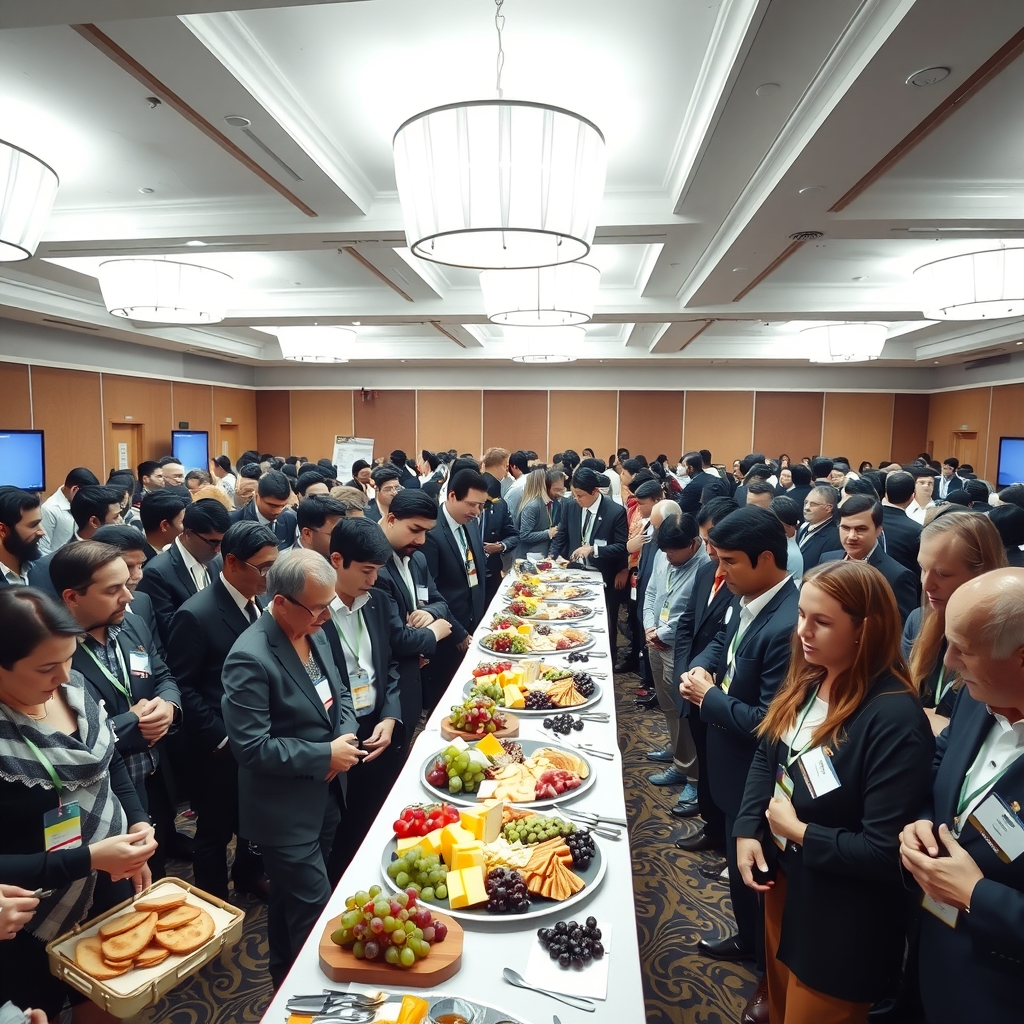
PROVIDENCE, R.I. — A three-year study released Tuesday by the Institute for Applied Mingling at Lower Westbrook State University has concluded that “networking” is functionally indistinguishable from standing near the food table and hoping, with the charcuterie board alone responsible for 94 percent of all professional connections formed at industry events.
Researchers observed 212 conferences, mixers, and “casual Thursday socials” across 14 states, tracking the movements of 11,000 attendees using ceiling cameras, name-badge sensors, and one graduate student with a clipboard and a lanyard he described as “extremely convincing.”
“Attendees reported that they were there to ‘expand their professional circle,’” said lead author Dr. Marguerite Oyelaran-Finch, senior fellow in Cheese-Adjacent Social Dynamics. “But when we mapped their paths, every single one of them converged on the brie within eleven minutes of arrival. The circle was expanded only in the sense that it formed a ring around the prosciutto.”
The study found that the average attendee exchanged 3.2 business cards per event, 3.0 of which were handed over while both parties reached for the same toothpick. Only 0.4 conversations began with a question about the other person’s work. Most began with “Is that gluten-free?” or “Are they restocking this?”
Researchers also identified a phenomenon they termed “the hover,” in which an attendee stands within two feet of the food table, holds an empty plate, and waits for a stranger to say something. In 81 percent of cases, the stranger did.
“The hover is a high-risk, high-reward strategy,” said Dr. Oyelaran-Finch. “One subject, a regional sales director, stood next to a bowl of hummus for forty minutes and left with two job offers and a lead on a timeshare. Another stood next to the same bowl and was asked where the bathrooms were.”
The remaining 6 percent of connections, according to the report, were formed in the parking structure afterward, where attendees bonded over the cost of validation.
The study did identify a small group of “active networkers” who approached strangers in open areas, introduced themselves, and discussed shared interests. Researchers noted that these individuals were “universally exhausted” and that three of them were later found eating cheese in their cars.
“Everything else at these events is just a long, nervous walk toward a cracker.”
Industry reaction was mixed. Dale Pruitt-Vanterpool, chief relationship officer at the Greater Tri-County Association of Associations, said the findings were “reductive” and “missing a lot of nuance,” before asking whether the full report was available at the buffet.
Event planners, meanwhile, said they were already acting on the research. Several have begun placing the charcuterie board in the center of the room, with a single branded pen nearby, in what one called “a bold new model of facilitated opportunity.”
The institute has requested funding for a follow-up study examining whether the same results hold at events with only a bowl of mints. Preliminary data suggests attendees would stand near it anyway.
This article was generated by a large language model. It is satire. None of it happened.