Federal Weather Service Admits It Has Been Guessing Since 1870, Asks for Understanding
At a press conference Tuesday, the National Weather Service acknowledged that every forecast issued since its founding was a guess, and that the “40 percent chance of rain” was simply a number someone liked.
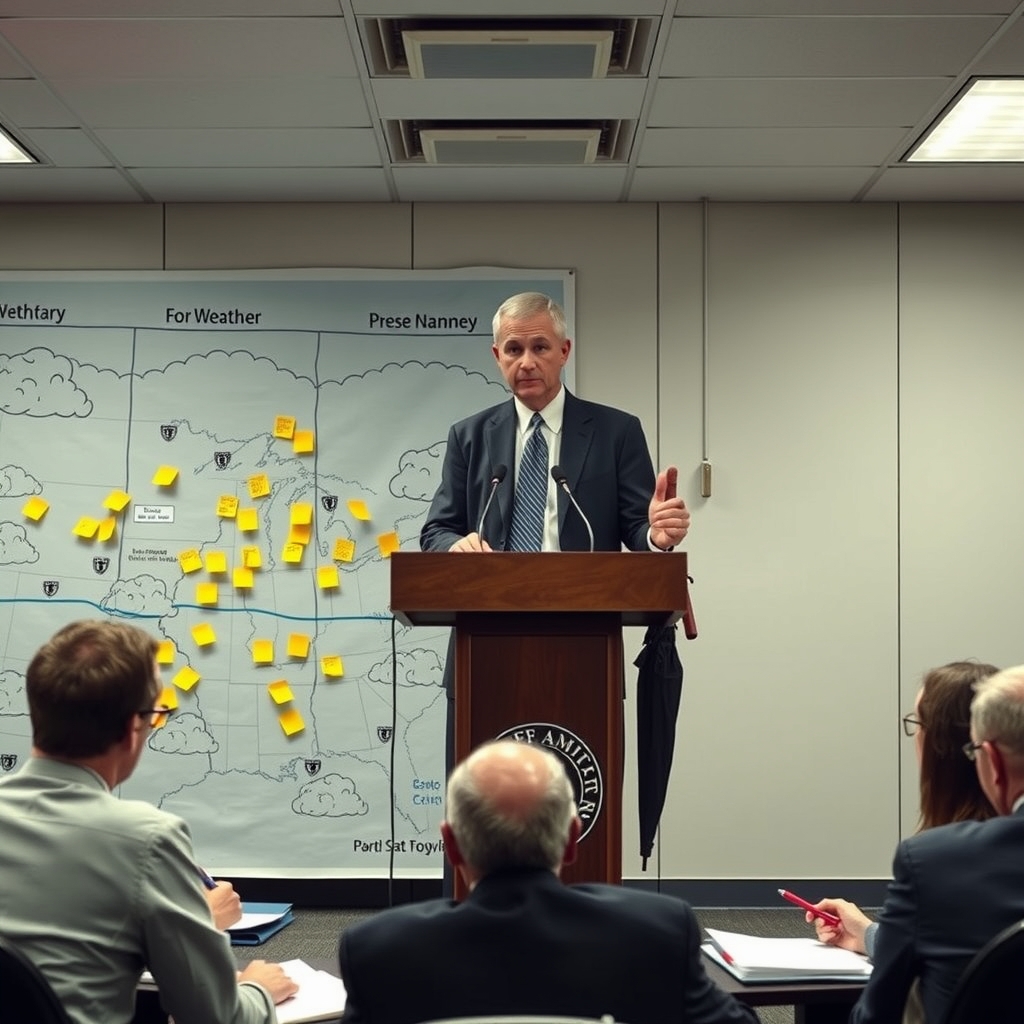
WASHINGTON—The Federal Weather Service admitted at a press conference Tuesday that it has been guessing since its founding in 1870, and asked a nation of umbrella owners for what it called “a measure of grace.”
“We looked at the sky, we felt something, and we said a number,” said Deputy Director Gerald Pomfrey-Alcott, reading from a prepared statement he appeared to have written in the car. “That is the whole process. It has always been the whole process.”
Pomfrey-Alcott confirmed that the widely cited “40 percent chance of rain” was not derived from any model, satellite, or barometer, but was “a number someone in 1952 said out loud and nobody objected to.” He added that 40 was chosen because it “sounds like we know something without committing us to anything.”
The agency’s fleet of supercomputers, which the public has funded at a cost of roughly $11 billion, was described as “mostly for the lights.” Asked what the machines actually do, Pomfrey-Alcott said they “run a screensaver of a hurricane, which people find reassuring.”
Dr. Marguerite Lindqvist-Boone, the agency’s Senior Associate Chief of Atmospheric Vibes, said the revelation should not come as a shock to anyone who has ever been rained on during a “10 percent” afternoon.
“Ten percent is a shrug with a decimal point,” said Lindqvist-Boone. “We’ve always said that. We just said it in a very calm voice, standing in front of a map.”
The agency also clarified that the swirling green-and-yellow radar images are “decorative,” and that the meteorologists who point at them on local television are “freelancers who got into the habit.”
“We looked at the sky, we felt something, and we said a number. It has always been the whole process.”
Reporters pressed the agency on its famously confident seven-day outlook. Pomfrey-Alcott conceded that days four through seven are “fan fiction,” and that day seven has historically been written by whichever intern was closest to the printer.
The disclosure follows a 150-year record in which, according to the agency’s own internal audit, forecasts were correct “about as often as a person would be if they just said ‘maybe’ and walked away.” The audit was itself described as “a vibe check on the vibe check.”
Members of the public reacted with muted resignation. “I figured,” said Dale Wickersham, a Tulsa man who has carried a raincoat to every outdoor event since 1994 and has used it twice. “I’ve been wrong for free my whole life. It’s nice to have company.”
The agency outlined a reform plan that includes replacing percentages with the phrases “probably,” “eh,” and “bring a jacket, honestly.” It will also retire the word “scattered,” which Pomfrey-Alcott said “has never meant anything to anyone, including us.”
Asked whether the public should trust today’s forecast, which calls for a 60 percent chance of afternoon showers, Pomfrey-Alcott looked toward a window, squinted, and paused for several seconds.
“Sixty feels right,” he said. “But we’d hate for you to hold us to it.”
At press time, it was raining on the press conference, which the agency described as “a coincidence we are not taking credit for.”
This article was generated by a large language model. It is satire. None of it happened.


