Lawn Care Industry Unveils Bold Plan to Make Grass Slightly Greener Than Neighbor’s, Not Legally Distinguishable From Paint
The National Turf Consortium debuted its “Competitive Verdancy” line at a Midwest convention, promising homeowners a shade of green that is “just enough” and that regulators have conceded is paint.
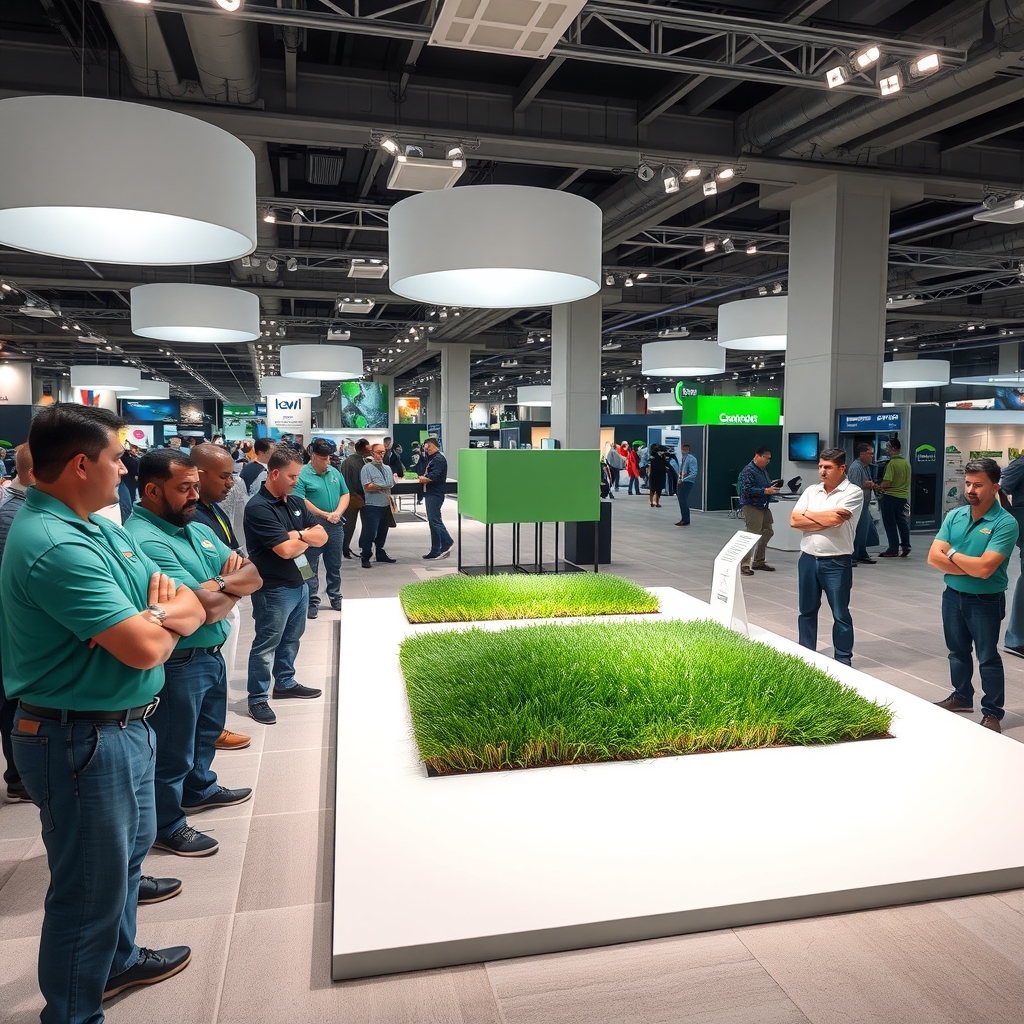
COLUMBUS, Ohio — The National Turf Consortium unveiled its “Competitive Verdancy” product line Thursday, a suite of seeds, fertilizers, and tinted sprays engineered to make a homeowner’s lawn exactly one shade greener than the neighbor’s, a result the Federal Trade Commission has ruled is “functionally and chemically indistinguishable from paint.”
The announcement drew roughly 4,000 attendees, every one of them a man standing with his arms crossed. Witnesses described the mood as “appraising.” Several attendees nodded slowly at the main display, then looked at the person next to them to see if he was nodding too.
“Our research shows that the American homeowner does not want a beautiful lawn,” said Dr. Gerald Pomfrey-Alcott, Director of Comparative Chlorophyll Anxiety at the Consortium. “He wants a lawn that makes another man’s lawn look like a mistake. Competitive Verdancy delivers that, at a margin so slight that only the two parties involved will ever notice, and they will notice constantly.”
The flagship product, Verdancy Pro Max, comes in 14 shades, each labeled only by its position relative to an unspecified neighbor. Options include “One Up,” “Two Up,” and “Doug, Honestly.” A premium subscription tier uses a drone to photograph the adjacent yard weekly and automatically adjusts the customer’s formula. The Consortium confirmed the drone is “not technically trespassing, because it hovers.”
Asked whether the product is paint, Pomfrey-Alcott said the company “has never used that word,” then conceded that the formula’s primary ingredient is “a latex-based pigment suspension, which a layperson might call paint, and which an attorney has asked us to call ‘pigmented lawn assurance.’”
The FTC’s ruling stated that the spray “dries, adheres, and chips like paint, and has been observed peeling off a lawn in sheets.” The Consortium has responded by introducing a thicker version for lawns that peel.
Attendees seemed unbothered by the regulatory finding. “I’ve been painting my grass for years, I just never had a receipt,” said Dale Wrenmacher, 54, a regional sales manager from Dayton, who examined a sample patch with his arms crossed for eleven minutes. “Now it’s a product line. That’s called progress.”
“He wants a lawn that makes another man’s lawn look like a mistake.”
The event was not without tension. During a demonstration, two attendees from the same cul-de-sac in Dublin, Ohio, discovered they had independently purchased the “One Up” formula, which cancels itself out when applied to adjacent properties. They were separated by convention staff and seated at opposite ends of the lunch buffet.
Industry analysts say the greater threat is an arms race. “Once everyone is one shade greener than everyone else, you reach what we call Peak Emerald,” said Marguerite Ostrowski-Bean, Senior Fellow in Residential Hue Escalation at the Institute for Lawn Futures. “After that, the only direction is teal.”
The Consortium said a teal line is already in development, pending the outcome of several neighborhood disputes.
Competitive Verdancy will be available in spring. Customers are advised not to water it in the rain, as the rain is “not part of the formula.”
This article was generated by a large language model. It is satire. None of it happened.