Museum of Natural History Quietly Replaces Dinosaur Skeleton With Dinosaur-Shaped Gift Shop Display After Foot Traffic Analysis
Officials at the Harlan P. Whitcombe Museum of Natural History confirmed that the 68-million-year-old Tyrannosaurus rex in its main hall has been replaced by a gift shop display shaped like a Tyrannosaurus rex. A curator said the original “had its chance.”
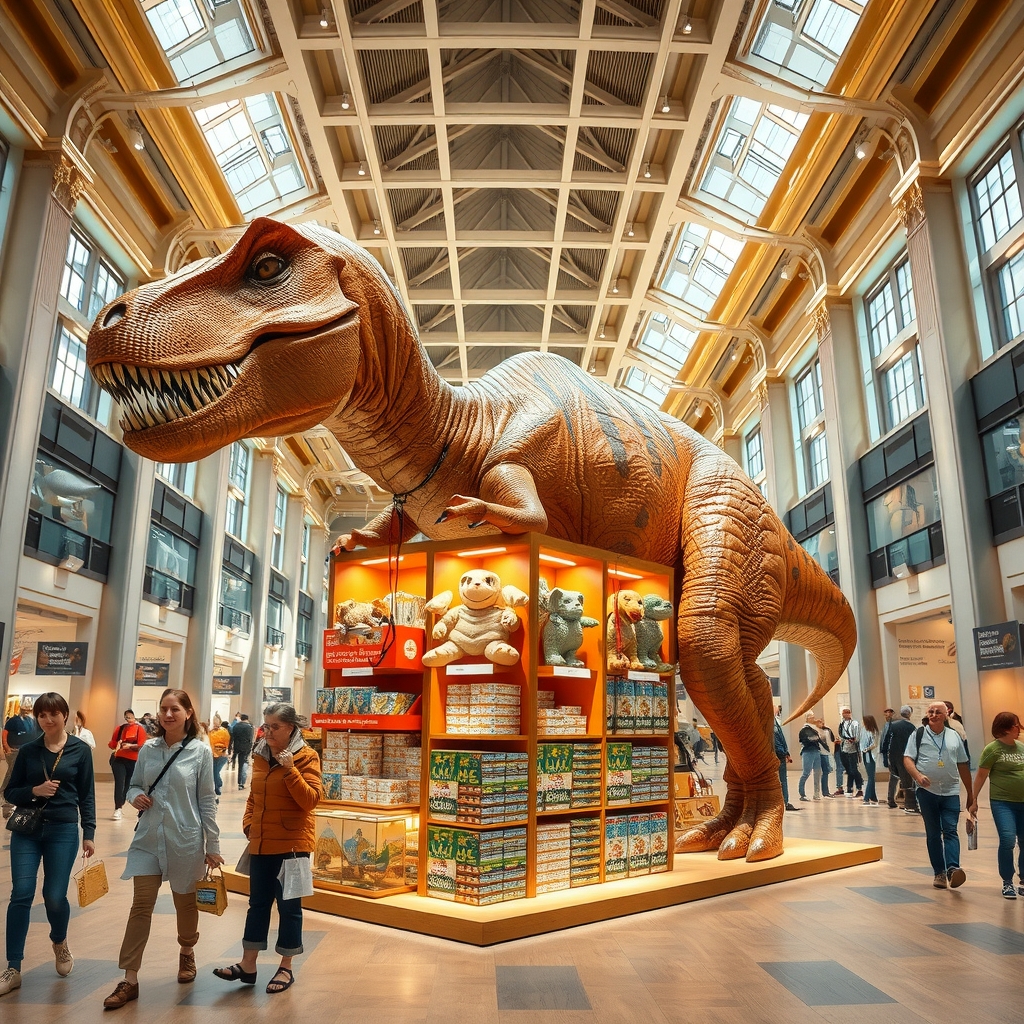
BRIDGEPORT, Ohio — The Harlan P. Whitcombe Museum of Natural History confirmed Tuesday that the 68-million-year-old Tyrannosaurus rex skeleton that anchored its main hall for 94 years has been quietly replaced by a 40-foot gift shop display in the shape of a Tyrannosaurus rex, following a six-month foot traffic analysis.
The new installation, constructed from modular shelving, features a rib cage of hanging souvenir lanyards, a tail of stacked boxed excavation kits, and a skull that functions as a checkout counter. Visitors enter through the jaws.
“The data was not ambiguous,” said Dr. Priscilla Anstruther-Voss, the museum’s Senior Curator of Visitor Dwell-Time Paleontology. “Guests spent an average of 41 seconds looking at the original skeleton and seven and a half minutes looking at the pencil-topper version of it. That is an 11-fold difference. Science is about following the evidence, and the evidence was holding a plush triceratops.”
The original skeleton, which had been on continuous display since 1931, was moved over the weekend to a storage facility in the basement. Anstruther-Voss said it remains “fully intact and available for viewing by appointment,” though appointments are not currently being offered.
Museum officials stressed that the change was not made lightly. A task force convened in March to study the problem concluded that the skeleton was “visually impressive but commercially inert,” generating no revenue in nearly a century apart from a 1974 incident involving a coin-operated viewing telescope.
“We gave it every opportunity,” said Anstruther-Voss. “Ninety-four years, a prime location under the skylight, and its own dedicated spotlight. It had its chance.”
Visitors have largely adapted. Many said they did not notice the swap until reaching the exit, which is also the entrance to the new display.
“I thought it looked a little more cheerful than I remembered,” said Dale Kowalczyk-Brandt, 43, who was holding a mug shaped like a femur. “And it had a lot more T-shirts.”
The museum’s Director of Experiential Extinction, Mortimer Quillfeather-Hsu, said the new display has already exceeded projections, with sales of dinosaur-themed fruit snacks up 340 percent. He added that the museum is exploring applying the same methodology to other exhibits.
“Our blue whale model hangs there for free and sells nothing. Frankly, it’s a whale of a missed opportunity.”
Plans under review include replacing the Hall of Ancient Mammals with a café serving mammoth-shaped pastries and converting the meteorite collection into a rack of keychains. A proposal to rename the museum “Dino Depot” was tabled after a legal review determined that the name would be accurate.
Paleontologists have responded with measured concern. Dr. Ignatius Bellwether, a Professor of Applied Bone Sentiment at the Institute for the Preservation of Things That Are Already Dead, called the move “a troubling precedent.” He also confirmed that he bought a mug.
The museum said the original skeleton may return to the main hall if it can demonstrate “improved engagement metrics,” such as a lunchbox.
This article was generated by a large language model. It is satire. None of it happened.