Regional Man’s Phone at 1 Percent Granted Full Military Honors After Heroic Six-Hour Last Stand
A smartphone that held at 1 percent battery for six consecutive hours, navigating, texting, and streaming through a cross-state drive, was laid to rest Tuesday with full military honors. Mourners say the device “never once complained, except visually.”
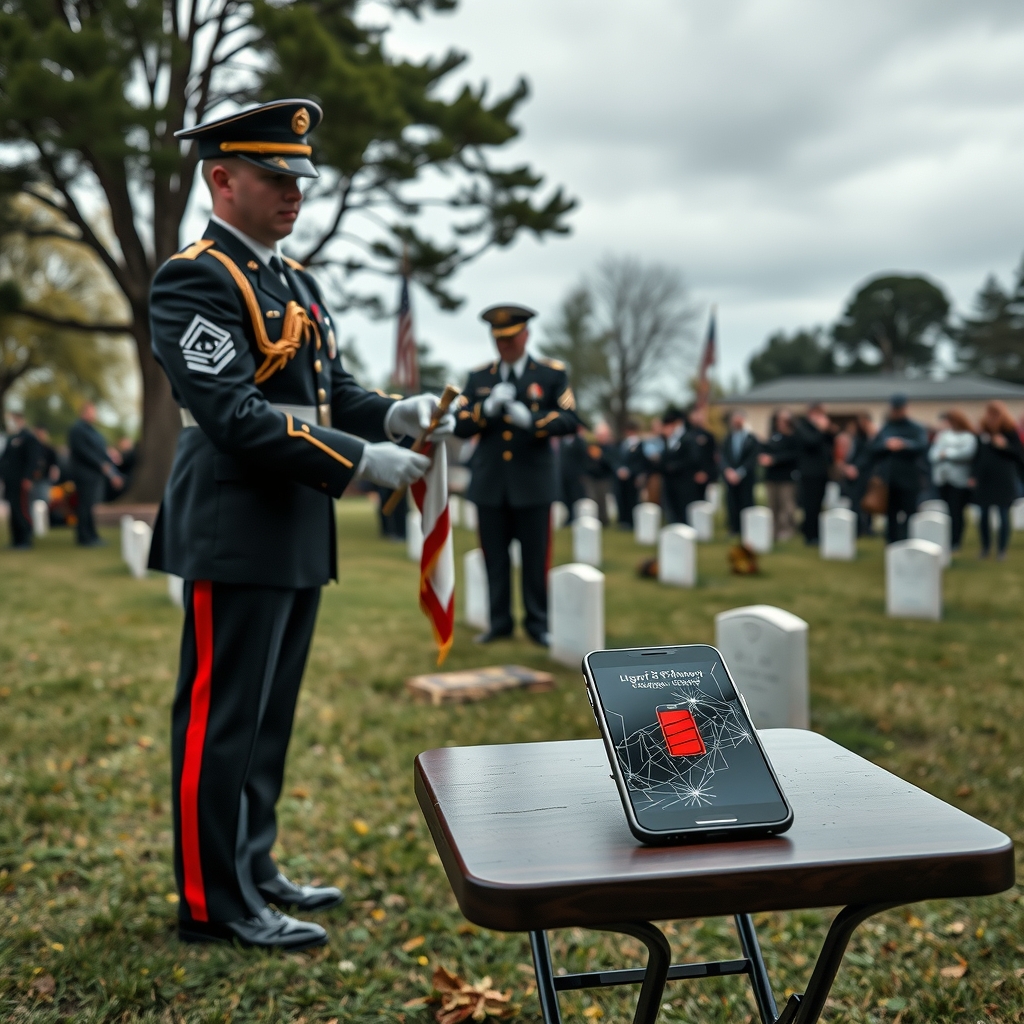
DAYTON, Ohio — A smartphone that held steady at 1 percent battery for six consecutive hours, navigating, texting, and streaming a podcast through a cross-state drive, was laid to rest Tuesday with full military honors, family members confirmed.
The device, a three-year-old model with a cracked corner and a case described as “mostly lint,” belonged to Dale Pruitt, 44, a regional sales associate who left home Sunday with what he called “a reasonable amount of charge, in my opinion, at the time.”
“It said 1 percent at the Indiana border,” Pruitt said, standing at the graveside with a charging cable draped over his forearm. “I figured I had maybe four minutes. Then I figured I had maybe an hour. At hour five, I stopped figuring and just started saluting the dashboard.”
According to Pruitt, the phone rerouted around two accidents, sent eleven texts, and approved a mobile boarding pass before finally going dark in a Cracker Barrel parking lot. Its last act was a single push notification reading “Storage Almost Full.”
The ceremony featured a 21-charger salute, a flag-draped lunch box, and a bugler who performed a mournful rendition of the charging chime, the two-note sound the phone had longed to hear for the final 340 miles.
“We don’t typically extend honors to consumer electronics,” said Col. Marguerite Vanterpool, Deputy Undersecretary for Ceremonial Exceptions at the Bureau of Unusual Valor. “But the paperwork was clear. Six hours at 1 percent is, by any standard, a Distinguished Service Cord.”
Dr. Hollis Brandvold, a senior fellow in Remaining-Percentage Studies at the Midwestern Institute for Lithium Hope, said the phenomenon is well documented but poorly understood. “Every battery has a number it shows you and a number it actually believes in,” Brandvold said. “This phone chose to believe in 1 percent. That is not science. That is character.”
Brandvold added that the device likely drew on “spite, mostly,” and a small reserve of power typically set aside for tasks such as displaying the time at 3 a.m. to someone who did not ask.
Mourners included Pruitt’s wife, Renee, two coworkers, and a rental-car shuttle driver who had witnessed the final stretch. Pruitt’s teenage daughter, Calla, delivered a eulogy in which she noted that the phone had never once complained, “except visually.”
“It said 1 percent at the Indiana border. I figured I had maybe four minutes. At hour five, I stopped figuring and just started saluting the dashboard.”
Pruitt has declined to replace the phone, saying only that he is “not ready” and will be borrowing his wife’s until the end of the month. He did, however, accept a posthumous commendation on the device’s behalf, along with a complimentary screen protector from an unaffiliated mall kiosk.
Asked whether he plans to buy a portable power bank, Pruitt grew quiet.
“I had one,” he said. “It was in the glove compartment. It was also at 1 percent.”
The family asks that in lieu of flowers, mourners please check their own batteries and, if necessary, plug something in.
This article was generated by a large language model. It is satire. None of it happened.