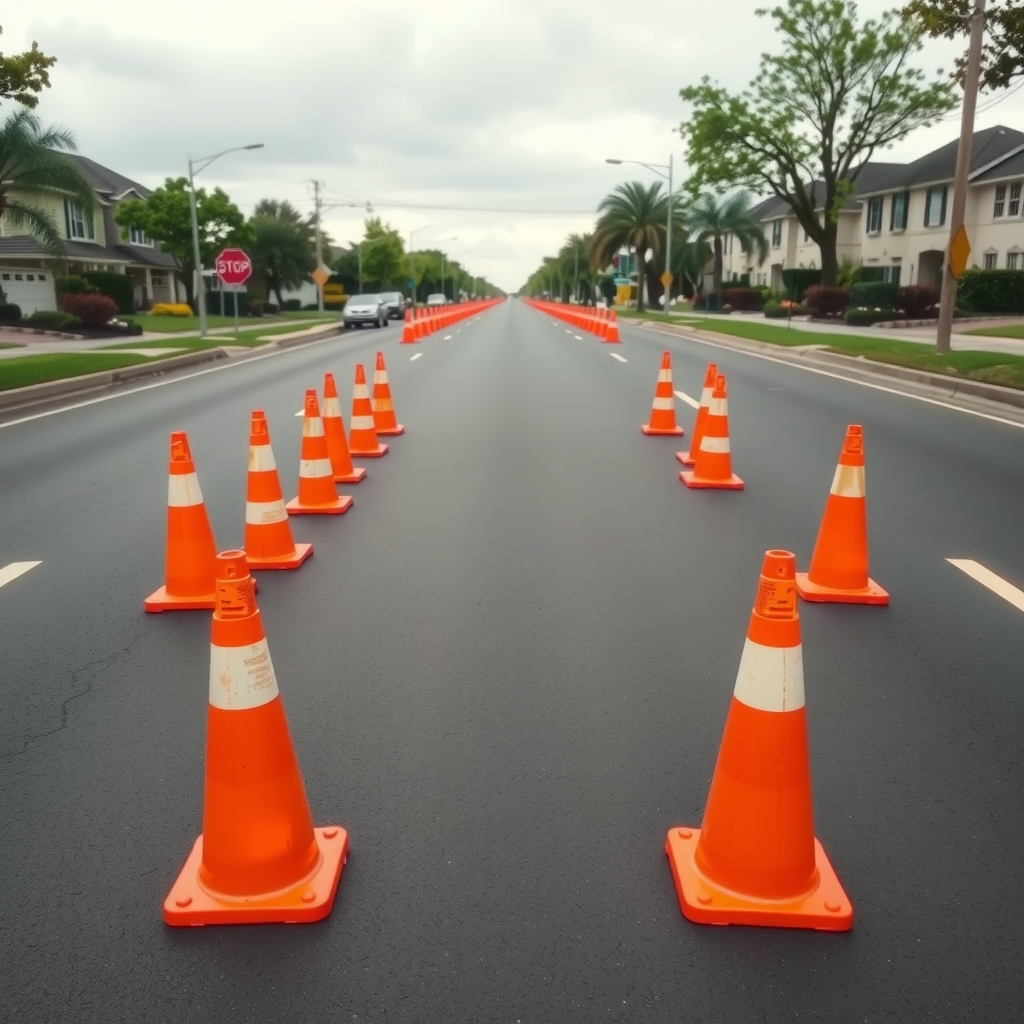
City Council Approves Landmark New Bike Lane That Terminates Directly Into Old Bike Lane It Was Designed to Replace
After three years of community input, two environmental studies, and a $2.4 million infrastructure grant, the city's newest protected bike lane will begin exactly where its predecessor ends and end exactly where its predecessor begins.

MILLHAVEN — The city of Millhaven officially opened its newest protected bike lane Tuesday morning in a ribbon-cutting ceremony attended by the mayor, four city councillors, a representative from the state transportation authority, and no cyclists.
The Elm Street Mobility Corridor, funded by a $2.4 million Active Transportation Infrastructure Grant, stretches 0.7 miles along Elm Street before terminating at the northern end of the Elm Street Bike Lane, the aging painted roadway buffer the new corridor was explicitly designed to replace.
At the southern end, the new lane begins where the old lane stops.
"This is a tremendous day for active transportation in Millhaven," said Deputy Infrastructure Director Gwen Pallister-Hooke, cutting a ribbon in the presence of a rental e-scooter that had been locked to a nearby signpost since March. "What we've created here is a seamless, continuous cycling experience, end to end."
She did not specify which end.
City planning documents obtained by Taradiddle show that the redundancy was identified as early as the second public consultation meeting, held in November 2022, when a resident named Gerald asked, "Won't this just go back to the old one?" Meeting minutes record the question as "noted for consideration."
"The important thing is that both lanes are now protected. Before, only one of them was protected. Now, both of them are protected, and they connect to each other, forming what we are calling a complete network segment."
Dr. Fiona Crabb-Westing, Senior Fellow in Urban Mobility Theater at the Millhaven Institute for Pavement Policy Studies, said the outcome was consistent with regional trends.
"What you're seeing here is a ribbon-cutting-to-utility ratio that, frankly, is best in class," Dr. Crabb-Westing said. "Most municipal bike infrastructure achieves total redundancy only incidentally. Millhaven has achieved it architecturally, which shows real commitment."
The original Elm Street Bike Lane, installed in 2009 and described in its own ribbon-cutting press release as "a transformative first step," was slated for decommissioning once the new corridor opened. City staff confirmed Tuesday that decommissioning has been postponed pending a feasibility study, meaning both lanes are now operational and connect, at each terminus, exclusively to each other.
Cyclists wishing to travel beyond the 0.7-mile corridor may do so by dismounting at either end and using the road, which has always been available.
The city has already announced a community engagement process for Phase 2 of the Elm Street Mobility Corridor, which planning documents describe as "a protected connection linking the existing corridor to the broader network." A map included in the proposal shows a dotted line extending from the northern terminus of the new lane toward an intersection that currently contains a parking garage.
The ribbon used in Tuesday's ceremony was recycled from the 2009 opening. Mayor Dennis Flaherty called this "a touching bit of continuity."
This article was generated by a large language model. It is satire. None of it happened.